Posts

Showing posts with the label Emerging Markets

IB Net Payout Yields Model

Bombay Stock Index At All Time Highs?

Image
With so much negative news surrounding emerging markets and the strong gains in the US market, it is interesting to see India slowly climb to multi-year highs. In the last couple of months, the Bombay Sensex Index has climbed over 21,000. The index originally reached over 20,000 in December 2007. Since that point it has gone virtually nowhere. See the chart below: The best that I can tell the index actually reached an all-time high after spending the last six years consolidating. India appears set for a major breakout and maybe the best stock to play that move in the US would be ICICI Bank (IBN) . The major Indian bank with a market cap in excess of $20B actually hit a peak of over $70 back in early 2008. The stock has lost 50% of its value during those nearly 6 years (sounds like the NASDAQ bubble from 2000). It might be a good stock to own in 2014. Disclosure: No positions mentioned. Please review the disclaimer page for more details. 
Indian Inflation Continues The Descent

India's headline inflation plummeted in December following the previously announced sharp drop in food prices. The inflation figure came in at 7.5% down from 9.11% rate reported for November. While generally inline with consensus, the reading provides solid confirmation that India has been able to use monetary policy to slow the inflation rate. Now the real question is how low the rate will drop and whether this will provide enough room for the RBI to drop interest rates. Simple math suggests the rate will see further drops as such a huge drop suggests month over month inflation is flat lining. Of the components, manufacturing inflation remained at 7.4% while fuel inflation only saw a modest decrease to 14.9%. Just don't see how fuel inflation can remain so high if oil is virtually flat this year. Only currency could explain stubbornly high prices and that will reverse in due time. Per CNBC.com report : The wholesale price index (WPI), the main inflation gauge, rose ...

India Food Inflation Drops to 6 Year Low

Image
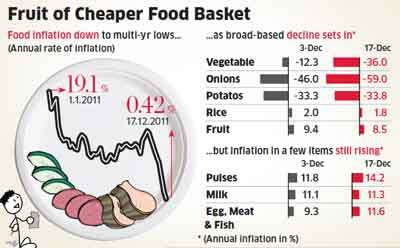
Don't look now, but food inflation in India is now under control. Prices of primary food items r ose only 0.4% in the week ended December 17 from a year ago. Lower food inflation places less strain on the economy and lowers the overall inflation rate allowing the RBI to begin easing monetary policies. Rates were increased 13 times since March 2010 and has started having a major impact on growth. Inflation is expected to drop to around 6% in the next few months and maybe lower if food prices are any indication. As I wrote recently for Seeking Alpha, India stocks are ripe for buying as inflation comes under control. A lot of the fears were misplaced as the sharp drops in commodities from the credit crisis lead to artificially inflated price increases by the start of 2011. Now after some cooling of growth, inflation rates have dropped dramatically and as the world economy goes into 2012, prices for most commodities will show year over year declines. The the deflation calls s...

China PMI Improves Though Remains Negative

The HSBC Purchasing Manager's Index inched up to 48.7 in December from 47.7 in November. Though still negative it is a number that economists equate with 12-12 percent industrial output. The number has been holding just sub 50 since July so at least the stability is suggestive of a soft landing. Not to mention China has already begun an easing process that should help going forward. Lower inflation followed by low PMIs will allow for quicker policy cuts especially on bank reserves. HSBC Purchasing Manager's Index inched up to 48.7 in December from a 32-month low of 47.7 in November but fell short of the flash reading of 49. HSBC believes a PMI reading of as low as 48 in China still points to annual growth of 12-13 percent in industrial output.  Still, analysts are looking for signs of stabilisation in the factory sector and are anticipating a shift by Beijing to a more supportive economic policy stance to prevent a sharp slowdown.   Chinese stocks have been att...

Emerging Market Stocks Are Ripe For Buying: Russia Focus

This is the 4th article in a series focusing on the investing opportunities in emerging markets presented by the large selloff during 2011. The first 3 articles focused on India, Brazil, and China respectively. Russia will be the focus this time and the country is no different than the others where inflation has been a big factor to the market declines. Russia inflation fell to 6.8% in November. In most economies, 7% inflation would be disastrous and even in other emerging markets like China and Brazil that amount would be extremely high. In Russia though, 7% inflation has actually been closer to the lows over the last couple of decades. Read the full article at Seeking Alpha. Disclosure: No positions mentioned. Please review the disclaimer page for more details.

Emerging Market Stocks Are Ripe For Buying: China Focus

This is the 3rd in a series or articles focusing on the emerging markets that have come under fire this year. The first 2 articles focused on India and Brazil, while this one will explore the opportunities in China. The main culprit for the emerging market declines has been the supposed rampant inflation. China has been no exception to this fear. Inflation, though, has decidedly peaked in China with the November figure showing month over month declines. This has allowed China to lower bank reserve ratios once already and will likely lead to further cuts especially since the government raised ratios to over 20% at the start of this year. Read the full article at Seeking Alpha. Disclosure: Long CCIH. Please review the disclaimer page for more details. 

Emerging Market Stocks Are Ripe For Buying: Brazil Focus

This is the 2nd article in a series focusing on whether now is the time to invest in emerging markets. The first article which focused on India concluded that while some appealing stocks were at very discounted levels, investors need to wade into the stocks carefully, in order to not catch the proverbial falling knife. This article focuses on the largest Latin America economy, Brazil. It faces similar problems, where high inflation led to numerous interest rate increases by the central bank, leading to a slowing down of the economy. The major difference, though, is that Brazil has already been aggressive-- with three rate cuts of 50 basis points each-- while India is still pondering whether to cut rates. The country also has two potential catalysts, with the World Cup arriving in 2014 and the Summer Olympics in 2016. Both events will require large infrastructure spending that should benefit not only the economy, but a lot of the stocks traded in the U.S. Read the full article at...

India Food Inflation Hits 4 Year Lows

As I've been saying the last few months, the inflation scare was a tad overdone. A good part of the emerging market inflation had to do with plummeting of prices in 2009 followed by the sharp rise in 2010. This lead to the misleading year over year increases instead of looking at a smoother change over the last 3-5 years. Last night, India reported food inflation had dropped to 4.35% for the week ending December 3rd. This was the lowest reading since February 2008. Amazing that India didn't report any numbers below that for the rest of the crisis especially in late 2008 or early 2009. On top of this,, the economic advisor listed in the Reuters report expects a drop to 3% within a month. We're working on a series of reports focusing on the emerging market opportunities especially now as inflation fears come under control and central banks have begun loosening monetary policies. Not many better investments exist than buying high growth stocks at 1, 2, or 3 year lows ...

Emerging Market Stocks Are Ripe For Buying: India Focus

After a very cool summer in the markets, emerging market equities appear ready to emerge from the depths of massive losses for a warm winter. Inflation fears pushed investors away from the fast growing sector in droves in 2011, but now that inflation has begun easing now might be the time to return to the sector. Almost all of the emerging markets are down for the year, especially the leading BRIC markets. These inflation fears were somewhat misplaced since they were based on year over year comparisons of very volatile commodities. For example, copper prices soared to $4.6/lb in February which was a lot higher than in 2010, but only slightly higher than the peak back in 2008. Is that really inflation especially rampant inflation? Read the full article at Seeking Alpha. Disclosure: Long IBN. Please review the disclaimer page for more details. 

Emerging Markets Ready to Rumble Back?

After a year of crumbling stock markets some live now exists in the Emerging Markets. The main culprit has been high inflation, but for numerous reasons that is in the process of ending. Are argument all along has been an issue in how inflation reporting focuses on the year over year numbers as opposed to inflation over time. For example, commodity prices hit the inflation numbers hard towards the end of 2010, but only when you compare them to 2009 numbers. But going back a few years to 2007 and all of a sudden the 'inflation' doesn't exist anymore. Naturally China has been facing wage pressure along with most other emerging markets, but a lot of this was due to the relentless focus on the spiraling commodity prices. Not that pries for copper and oil have stabilized and even dropped from early 2011 highs, the numbers will start showing year over year drops even if Brent remains elevated around $110. All of this brings us back to focusing on emerging market stocks. Suc...

Wireless Weddings Discussion Too U.S.-Centric

After a wild couple of weeks in the domestic wireless sector following the  announcement  that AT&T ( T ) would purchase T-Mobile from Deustche TeleKom ( DTEGY.PK ) in a $39B deal, the speculation in the media has centered mostly around other potential wireless mergers in the U.S. Odd, considering that the U.S. market is very mature and past major telecom mergers a la Sprint ( S ) and Nextel in the wireless sector and MCI ( MCIP ) and WorldCom in the wireline/data sector have largely been flops. Between merging networks and combining billing systems, it's extremely time-consuming and underproductive to undertake (trust me, I know from first-hand experience of working the projects of trying to merge the billing systems of MCI and WorldCom)..... Read the full story at Seeking Alpha . Disclosure: Long MICC and NIHD for client and personal accounts. Please review the disclaimer page. 

Investors Fleeing Emerging Markets

Emerging markets stocks have been a major theme of the Opportunistic portfolios at Stone Fox Capital so I'm actually pleased to see investors fleeing emerging market stocks. Weak emerging market performance has reduced portfolio performance over the last 2-3 months, but it also provides opportunity for picking up long term growth stocks on the cheap. According to this AP report , EPFR Global reported that investors pulled $5.45B out of emerging market funds during just the second week of February alone. Yes, thats correct. It only took a few scary moments in the Middle East and some high inflation for investors to jump ship. Emerging markets have long been a traders market as investors jump in and out depending on the market direction. Oddly though, these markets provide a lot more long term growth and hence investors should be buying the dips in a lot of these markets. That doesn't appear to be the case though as I wrote yesterday about how the Chinese market has perked up...