Posts

Showing posts with the label Commodities

IB Net Payout Yields Model

Freeport-McMoRan: Don't Lose Faith

Freeport-McMoRan continues to trade below $10 per share due to weak copper prices. The company doesn't expect full production for the Grasberg mine to return until 2021. The stock is likely to struggle as the company reports weak Q3 cash flows due to copper prices ending the quarter at $2.60/lb. Buy the stock below $10 for the rebound in 2020 and beyond. While  Freeport-McMoRan  ( FCX ) didn't hold $10, the stock still has substantial value at this level. Copper remains weak due to the U.S. trade war with China, but this trading skirmish won't last forever. The  investment thesis  remains very bullish on the future of copper and this stock, especially when one can purchase shares below an identifiable value at $10. Read the full article on Seeking Alpha.  More commentary - WhoTrades Disclosure: Long FCX. Please review the disclaimer page for more details. 
Uranium Energy Corp. Sell-Off Provides Opportunity

Small-cap Insight Summary Uranium market provides long-term opportunity despite recent weakness. Japan approval of nuclear energy provides a near-term catalyst. Uranium Energy offers the cheapest valuation amongst the junior miners. After the Fukushima nuclear disaster in Japan roughly three years ago, the uranium market has been crushed. The spot uranium price is off by more than 50% and now sits at multi-year lows. The stock prices of junior uranium miners such as Ur-Energy Inc. ( URG ) and Uranerz Energy Corporation ( URZ ) are only now starting to recover while Uranium Energy Corp ( UEC ) continues plunging towards financial crisis lows. Read the full article at Seeking Alpha. Disclosure: No positions mentioned. Please review the disclaimer page for more details. 

Australia Iron Ore Exports Set to Rise Over 50% By 2017

According to this Reuters report on CNBC, iron ore demand is set to grow at 11% through 2017. Wait, didn't stocks initially plunge today due to fears of slower demand in China for iron ore? Talk about a confusing market with conflicting currents in the news. The actual news from BHP Billiton (BHP) today was that demand from China was "flattening" or otherwise growing in the mid single digits versus the double digit growth of the past decade. Slower growth, but still growth. How this is news was beyond me. Everybody should know by now that China wants slower growth. Stocks like Alpha Natural Resources (ANR) are down some 75% since early 2011 peaks. The market has already harshly punished this met coal producer to the extreme making the initial 6% drop further signs of a bottom. Remember that met coal is used with iron ore to produce steel. So now basically within 24 hours the media is spinning out reports of massive growth in iron ore demand and the expectations f...

Looks Like the Gold Run Is Over

Image
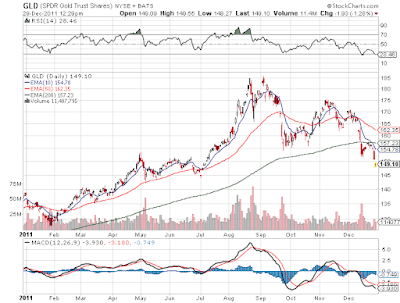
After an amazing decade run, Gold (GLD) has finally run out of steam. Nobody seems to know why gold would collapse now if Europe still a disaster area. Probably more that the trade became too crowded. Never was a fan of owning the physical commodity, but clearly it was a profitable trade. Anybody still owning gold should be careful as the GLD has broken solidly below the 200ema. No reason for Gold to remain in the $1,500 level. Update: Interesting post from Seeking Alpha. Note the huge difference in performance for Gold versus the Dow would make me concerned about owning last decades winner and this decades loser. 12:38 PM  A nice late-year run by stocks combined with the fall in gold prices has allowed the DJIA (with dividends included)  to pull ahead of the yellow metal's performance for 2011 - a massive turnaround from late summer, when gold was in the lead by 26%. Goldbugs retain a big advantage over the last decade though, +465% vs. a 54% total return for the D...

Emerging Markets Ready to Rumble Back?

After a year of crumbling stock markets some live now exists in the Emerging Markets. The main culprit has been high inflation, but for numerous reasons that is in the process of ending. Are argument all along has been an issue in how inflation reporting focuses on the year over year numbers as opposed to inflation over time. For example, commodity prices hit the inflation numbers hard towards the end of 2010, but only when you compare them to 2009 numbers. But going back a few years to 2007 and all of a sudden the 'inflation' doesn't exist anymore. Naturally China has been facing wage pressure along with most other emerging markets, but a lot of this was due to the relentless focus on the spiraling commodity prices. Not that pries for copper and oil have stabilized and even dropped from early 2011 highs, the numbers will start showing year over year drops even if Brent remains elevated around $110. All of this brings us back to focusing on emerging market stocks. Suc...

Rio Tinto Confirms Strong Commodity Demand

Interesting statement from Rio Tinto (RIO) ahead of an investor seminar. In summary, RIO continues to see strong demand for commodities not only now, but over the next 10 to 20 years. On the other hand, supply constraints remain due to regulatory issues, labor shortages, and geology constraints. Based on continued strong demand and supply issues, one would think the stock would be trading towards not only recent highs but also all times highs. That person would be very wrong. RIO is in fact down some 20% from February/April highs and not even close to the highs hit in 2008. The stock market disconnect just doesn't add up. Sure some commodities like Copper have plunged in the last few weeks, but prices remain close to all time highs. Clearly still at prices that suggest very healthy profits. One could easily argue that stock prices never reflected the commodity prices hit in the Spring. Even more precarious is the surging stock prices on some momentum stocks like Apple (AAPL)...

MF Global Looks to Take Advantage of Develeraging By Larger Financial Institutions

Image
At least that's the goal that new CEO John Corzine has outlined for MF Global (MF). What exactly that entails it's probably much harder to grasp and understand. MF clearly wants to move into investment banking and money management sectors left dismantled by the financial regulations and credit crisis. It's also areas that Corzine and his new COO likely understand following their careers at Goldman Sachs (GS). Whether they can be successful pushing MF into these competitive areas seems up in the air. According to FT.com report and news from an investment conference last month, Corzine made the statement that MF hoped to double to 4,000 employees within a couple of years from an aggressive move into investment banking and money management. Now that's a very aggressive statement and very atypical in the financial sector these days where most institutions are expected to decrease in size. MF has the potential to skate under the radar and take share from bigger rivals tha...

Joy Global Bullish on China & India Coal Demand

Joy Global (JOYG) has one of the more detailed earnings reports especially regarding end user demand for commodities like copper and coal that we favor as being in short supply because of the booming demand in China and now apparently India. The coal import demand from these 2 countries could be just staggering in the next few years. While copper could be in short supply in 2011 has industrialized countries return to stronger demand at the same time that China uses more and more. Everything points to higher commodity prices then the peak prices in 2008. See below for the outlook from JOYG. Market Outlook Demand for mined commodities continues to be dominated by strong imports from the emerging markets, and from China and India in particular, with improving but still weak fundamentals from the industrialized countries. For the past year, China has been the major source of increased demand for commodities as it deployed a more effective stimulus program and ...

The Bullish Case for Commodities

What's interesting about commodities is that when looking at the CRB index, it is basically flat since 2000. A time period in which the world has supposedly seen dramatically higher commodity prices. In reality they went way up and then collapsed back to 2000 levels. Considering that supply never caught up with demand, it makes us very bullish that the next 10 years will see the CRB Index exceed to the 2008 levels as most bull markets last 15-20 years. Iacono Research has a good summary on the bullish case for commodities. Read the whole report, but I liked this section best. These long-term cycles usually last about 15 years and come to an end with production surpluses driven by huge investments in infrastructure, not after a drastic cut in consumption due to a recession, as has been the case in 2008 and 2009. We are likely only about half way through the current commodities bull market, this one interrupted in a similar fashion as the last one back in the 1970s by a brutal r...